Which languages do you think are the most challenging?

As English speakers we are really spoilt, as pretty much the whole world is trying to learn English, and where large parts of the world have not yet fully succeeded in the endeavour, they are well on the way. So this takes the pressure off as native English speakers, which might be seen as a good thing. Unfortunately however, the all-too-common result on our part is the tendency toward extreme laziness when it comes to language learning! After all, why bother when the rest of the whole is beating a path to our door and doing all the work to make themselves understood.

Read more “Which languages do you think are the most challenging?”

Can I get my corporate blog translated?

These days a corporate blog is a widely-used means of generating quality content of interest to our target audience. Blogs contain keywords of popular Google searches and can be about pretty much any topic under the sun. The trick is that they be an interesting read in their own right, thereby attracting the type of potential customers that we want (in the case of a business), but also that they appear high in search-engine rankings by virtue of the use of keywords.

Read more “Can I get my corporate blog translated?”

The art of humour translation

Humour is a notorious area of difficulty in translations, as any translator will tell you. So much of humour is derived from double meanings and wordplay, small and subtle cultural references and so forth, which can often mean that it is (or can appear to be) simply untranslatable. This is not hard to understand since a great deal of humour has to do with the language itself, the way one word sounds like another or calls to mind certain associations, which belong strictly within the universe of that language and the culture related to it.

Read more “The art of humour translation”

Professional Croatian Translator: Nadira Ljevaković Garić – Part 2

Based on the few months I’ve been working with you, I can only say that you are one of the best clients I’ve ever had. I prefer long-term cooperations and BigTranslation offered me that very thing. It really is a pleasure to be a part of a professional team where you always get your questions answered and, at the same time, have the freedom to organize and decide the amount of work you accept – this is definitely something that makes BigTranslation stand out from other companies.

In what capacity do you work with BigTranslation and what was it that made you choose the company? In your opinion, what makes it stand out from other companies?

Based on the few months I’ve been working with you, I can only say that you are one of the best clients I’ve ever had. I prefer long-term cooperations and BigTranslation offered me that very thing. It really is a pleasure to be a part of a professional team where you always get your questions answered and, at the same time, have the freedom to organize and decide the amount of work you accept – this is definitely something that makes BigTranslation stand out from other companies.

croatian translatorWhat essential qualities or skills should a translator possess? What’s your ‘motto’ on translation, if you like?

In my opinion, working as a freelance translator is not as easy as it may seem. The knowledge of source and target language is essential. Translation goes way beyond being able to speak both the languages you’re working on. One needs to be able to flawlessly transfer both syntax and semantics from one language to another and make the final “product” as natural as the source it came from.
The process of translating itself aside, you need to organize your time, especially if you are working for many clients at the same time. You need to plan, communicate to clients, look for new ones and only then you do the translation work. Many people tell me that I’m having super easy time, a great job where I can work whenever I want to without realizing that I, myself, do the same amount of work which is distributed to 3-4 people in the companies they work in. My motto is: „Think, translate, fascinate“. The greatest pleasure I can have is my clients’. ☺

Imagine a world without translators. What would it be like?

I’ve recently read an interesting story. A professor from the USA was giving some lectures in Japan and started one of them with a joke that lasted a few minutes. After he told the joke in English, he waited for the translator to do his job. The translator only talked for a few seconds and the audience burst into laughter.
After the lecture, the professor asked the translator how she managed to convey all the humour from his joke in only a few seconds. She shrugged and said: “I told them our American guest had just told a funny joke and that all should laugh.”
Most things that we use and buy daily go through the process of language adapting first which is obviously done by translators. Imagine you need to cook for some very special guests and go to a supermarket to buy spices, among other things. How spicy would your lunch be if you didn’t know which spices you used? That’s just a small example how important translation is.
In the bigger picture, translators are the ones connecting the world. Be it culture, finance, politics, education or any other crucial aspect of human existence and growth – none of it would be possible without translation.

Website translation: Making Vissually More Visible

Vissually wanted to expand to the French and British market, and so using our expert team we were able to translate their website into French and English efficiently, allowing customers from all over Europe to make the most of Vissually’s expert services, while Vissually can benefit from international business. Good news all round!

Vissually is a company which offers creative solutions to boost the sales of the brands they work with. With a carefully chosen team of engineers, graphic designers and printers, they create attractive products in countless formats, in order to meet their customers’ requirements and make them stand out among their competitors.

As with many companies, a lot of Vissually’s business is generated from their website. They have a successful website which is key to successful business, but Vissually have come up against a challenge which many successful businesses face – their market is limited to Spanish customers. They wanted to expand their business to reach out to a wider audience, and to do this, they needed to translate their website into different languages. To provide this important service, they chose BigTranslation. Here at BigTranslation we offer a website translation service into over 24 different languages, giving your business the opportunity of global success.

The key elements of website translation

What makes us unique is that we use native translators in order to make any translation sound as natural as possible. Native translators also know and understand the market needs and requirements of the audience for which they are translating, and are able to adapt the translation accordingly.

We also realise that no matter how good the quality of the translation may be, it has no relevance if it can’t be found on online searches. This is why we offer a SEO translation service, to allow your website to maintain high search engine visibility during searches from various countries. We specify key words and expressions which will increase the amount of users visiting the website.

Vissually wanted to expand to the French and British market, and so using our expert team we were able to translate their website into French and English efficiently, allowing customers from all over Europe to make the most of Vissually’s expert services, while Vissually can benefit from international business. Good news all round!

Linguistic variations: Minor Mistakes, Major Consequences

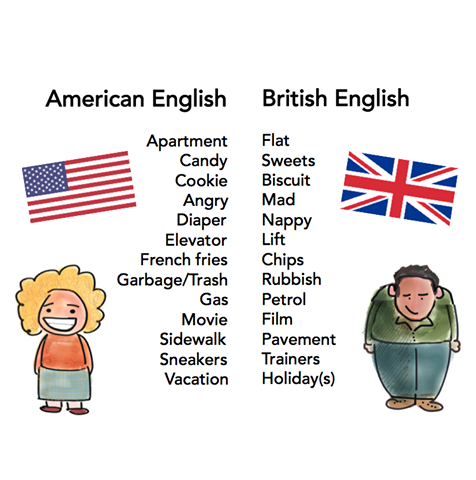
It is well known that English is among the most widely spoken languages in the world, along with Chinese (Mandarin) and Spanish, but we never specify which English we are referring to. Although we think of English as being one universal language, it actually has many variations across the globe.

It is well known that English is among the most widely spoken languages in the world, along with Chinese (Mandarin) and Spanish, but we never specify which English we are referring to. Although we think of English as being one universal language, it actually has many variations across the globe. This is why it is important to bear in mind your target audience when you are translating – because one word may have two very different meanings depending on where you are from.

Do you dare to assume linguistic variations are insignificant?

For example, if you are giving an address to the first floor of a building, an American would go to the ground floor of a building, whereas a British person would be waiting one floor above.

Another issue may arise when a party invitation has the instructions fancy dress. At an American party this would mean formal dress, black tie and ball gowns, but a British person could turn up in any outfit from a Mickey Mouse costume to a Superman cape – not a mistake you want to make!

Another common error is the difference with the word pants in the UK and the USA, as in the USA it means trousers, whereas in the UK it means underwear. Another piece of clothing American’s tend to find confusing is the jumper. Although to British people this is quite clearly an item to keep you warm in winter, in America a jumper is somebody who commits suicide by jumping off a building or bridge. Fortunately the popularity of Harry Potter, and particularly Ron Weasley, across the globe has helped Americans to understand the commonly used British meaning!

But perhaps the most embarrassing slip up you could make is with the word “rubber”. In Britain, this is a commonly used classroom object for erasing mistakes, and nobody would bat an eyelid if a 7-year old said “Please may you pass me the rubber”, but in America this would seem very strange, as rubber in America means condom!

Native translators, and say goodbye to misunderstandings!

It is clear to see that for different audiences across the globe, the same word may have very different meanings and connotations depending on its variation, which is why when doing a translation it is of the utmost importance to use experienced translators who know their language and their target audience to avoid these simple but significant errors.

Website Translation: More Than Just Words!

As the modern world is advancing at such a rate, companies are using online resources more and more to expand and improve their business. An impressive website is essential for a successful business, but in order to really reach out to a global client base, websites need to be translated, a task which is no easy feat.

As the modern world is advancing at such a rate, companies are using online resources more and more to expand and improve their business. An impressive website is essential for a successful business, but in order to really reach out to a global client base, websites need to be translated, a task which is no easy feat.

Native translators make the difference

At BigTranslation, all of our translators are native to their target language, which is key to a successful translation. Primarily, this is because they are able to use a variety of language, which sounds natural to the target audience making it easy to read. For example, somebody may be able to write perfect US English, but for a British audience this will not sound natural.

Native translators also have the advantaimagen-blog-compressorge of living in the country for which they are translating, meaning that they know and understand the market needs, and therefore which points need to be emphasised, and also those that may be less relevant to the audience.

Similarly, native translators are familiar with cultural differences between countries, and therefore are able to translate a text without causing any offence or confusion to their target audience, by choosing the information included and the style in which the information is presented effectively.

Marketing, a winning bid

Once the text of a website is translated, the next step is to work on the marketing within the website. With a different target audience there comes different cultural differences and customs, and this must be taken into account when translating a website. An example of this would be considering images and colours within the website. For instance, in some countries having a moustache is deemed as mature and attractive, whereas in China it is seen as a sign of bad luck! Therefore on a Chinese website, it would not be wise to use a model with a moustache to advertise a product.

In different countries, the preferred format of website varies. For example, in some countries a simple, spacious website may be favoured, whereas others may prefer a more exciting website with lots of colours and visual stimulation.

SEO to succeed

Finally, in order for the translated website to be successful, careful thought must be taken into translating SEO (Search Engine Optimisation). SEO is when key words are used to increase the amount of visitors to a website by obtaining a high place in the list of search engine results. This makes the website much more visible and greatly increases the number of visitors to a site.

Sometimes, the key words chosen for SEO in the source text are not successful key words in the target text, or may have more than one translation, therefore it is important to choose the translation which is most successful in the target country, or choose a new SEO altogether to create a successful website.

If you are looking to translate your website, our translation agency offers this service with translators from over 25 different languages and countries. Get in touch today to improve your business!

Transcription Services to Boost your Business Profile

Translations have allowed companies to grow like never before, and the profession is constantly expanding and evolving in order the meet the demands of clients from all across the world. One stand out example is the presence of videos across the internet, particularly on social media, which has led to a higher demand for audio and video transcriptions.

These days, people are more aware than ever of the importance that good language practice can have in terms of developing their business. Translations have allowed companies to grow like never before, and the profession is constantly expanding and evolving in order the meet the demands of clients from all across the world. Indeed, an increasing amount of companies are adapting their services to respond to the evolution of new media. One stand out example is the presence of videos across the internet, particularly on social media, which has led to a higher demand for audio and video transcription services.

More and more companies have been tapping into this; not just because the use of transcription allows for greater accessibility in the online global marketplace, but also because videos provide an excellent opportunity to boost a company’s SEO. For pages that produce longer videos, the advantages are even greater. Longer videos logically contain a larger transcript, which gives businesses a huge opportunity to target additional keywords in various languages.

Something for everyone

The benefits of transcription aren’t just reserved for e-commerce, where good SEO is always a priority; several studies conducted by a range of companies, including Discovery Digital Networks, SafeNet, and even the radio show This American Life have proven that adding subtitles and transcripts to videos can increase search traffic, page views, search rank, and engagement. A similar study by LiveClicker compared 37 web pages before and after adding transcripts. Pages with transcripts earned on average 16% more revenue than they did before transcripts were added.

Satisfy your clients

In addition, these pages also have an opportunity to increase customer satisfaction when they enlist the help of a transcription service. For example students, researchers, journalists or anyone else who’s looking for a particular moment or quote within a video will no longer have to trawl through minutes or even hours of footage just to find what they’re looking for. It’s all there, fully transcribed and easy to locate.

Clients with hearing difficulties are also accommodated for, and will appreciate a service that is not always available to them from other businesses and media outlets. Transcribing your video opens your business up to an audience of millions of people throughout the world who rely on this kind of service to make their multimedia experience worthwhile.

There are a number of reasons why businesses or individuals could require a transcription or captioning service. Whether you’re looking to provide your customers with greater satisfaction, someone requires a written copy of your video or audio file, or you want to use your content in new ways to spread your message to a wider audience and increase your SEO, transcription and captioning can provide innumerable advantages to you and your company.

What Happens to the English Language Now?

For native English translators and language undergraduates, one of the main points of concern in the aftermath of Brexit has been the prospect that English will now cease to be an official EU language. It is claimed that this scenario would result in English becoming far less in-demand, reducing the overall status of the English language in terms of business, culture and international relations.

What happens to the English language now?

For native English translators and language undergraduates, one of the main points of concern in the aftermath of Brexit has been the prospect that English will now cease to be an official EU language. It is claimed that this scenario would result in English becoming far less in-demand for European institutions, putting the jobs of language graduates in danger and reducing the overall status of the English language in terms of business, culture and international relations. This would all seem to make sense, given the fact that Ireland and Malta will be the only remaining countries in the EU with English as an official language. However, there’s reason to believe that things may not be so simple.

La Langue Universelle?

A quick scan of history shows that it wasn’t the presence of the UK which gave English its status as Europe’s lingua franca in the first place. When the British joined the EEC along with Ireland back in 1973, the official language of communication within the EU institutions was French. This was partly for historical reasons, and partly because the institutions were located in predominantly French-speaking cities: Brussels, Luxembourg and Strasbourg. The priority given to French was therefore justified, and the incoming UK and Irish officials alone were not numerous enough to make a difference to the language arrangement.

Native English Translators| BigTranslation

Things started to change about 20 years later. With the arrival of Sweden, Finland and Austria in 1995, English was used increasingly and was used to draft legislation, as it was the first foreign language of a growing number of new officials who required a common language for consultation purposes.
The 2004 enlargement of the European Union was its largest single expansion to date. 10 new countries became members, nearly all of whose national education systems offered English as first foreign language, not French. As a result, English became the most obvious common language of communication of new member states and therefore, by extension, the European Union as a whole. Now the EU works with 24 official languages.

Native English Translators still in High Demand

This is why even without Britain’s continued membership of the EU, one would suspect that English will continue to have a central role in communication between member states – at least for the considerable future. The Lithuanian official will still have to use English to communicate with her Dutch colleague, who will then be required to relay the information in English to his Czech boss. For English speaking language graduates, the image of this very common scenario may represent some light at the end of the tunnel.

In terms of translation post-Brexit, it is still the case that English-speaking officials, both administrators and clerical assistants, are in great demand. This puts translators from the Republic of Ireland, Europe’s largest remaining English speakers, in a rather advantageous position. Future selection competitions for recruitment, without competition from British nationals, should therefore favour Irish nationals slightly more than in the past.

Difference Between SEO Translation and Localisation

Many people think that localisation and SEO translation are basically the same thing – if you fall into this category of ‘many people’, then we suggest that you think again! While they are both types of translation, they each have different purposes, and most companies look for translators or translation agencies who can provide them with both of these types of translation as it helps to increase their business globally.

Localisation 

Many people think that localisation and SEO translation are basically the same thing – if you find yourself in this category of ‘many people’, then we suggest that you think again! While they are both types of translation, they each have different purposes, and most companies look for translators or translation agencies who can provide them with both of these types of translation as it helps to increase their business globally. The majority of translation agencies will only provide you with localisation, which is why agencies such as BigTranslation are so valuable as they also specialise in SEO translation. Let us now make the distinction between these two processes by starting with localisation. Localisation is a process which involves us adapting a text to make sure that it is culturally and linguistically appropriate for the target audience, most often used for website translations. This focuses on the more human aspect of translation as the target text will be received by a completely different culture, therefore native professional translators are often needed to carry out this kind of translation process, ensuring it has the same effect on the target audience as the source language audience. A good example of this is the translation of brand names; a good brand name in one language might be hilarious in another if translated literally (E.g., an Iranian soap product line is called ‘Barf’, which actually means ‘snow’ in Farsi, but becomes ‘vomiting’ in English). They could also be considered offensive or ridiculous: the Ford ‘Pinto’ means ‘penis’ in Brazilian Portuguese and the Rolls Royce ‘Mist’ would be ‘manure’ or ‘dung’ in German. Similarly, one excellent marketing slogan in one language could become a total disaster in another. An example of this is when American Airlines translated their slogan ‘Fly in Leather’ literally to ‘Vuela en Cuero’ in Spanish. The problem with this is that ‘Vuela en Cuero’ would actually be interpreted by Spaniards as ‘Fly Naked’ as it is a set expression in Spanish.  This is precisely why it is important to have a native translator of the target language to make localisation possible and ensure that a text is translated in such a way that it is familiar and appealing to the target culture.

SEO translation and localisation

SEO Translation 

Whilst localisation has the purpose of appealing to humans of a particular culture, SEO translation is different in the sense that its target is internet search engines. ‘SEO‘, as it is simply referred to, is essentially a ‘behind the scenes’ option which ensures that your products and services have search engine visibility in the target country. Every single attribute on a web page such as keywords, expressions, tags, titles, metatitles and anchor texts should be translated in order to make the web page attractive to search engines in the target language. In this sense, SEO is a requirement for the best quality translation of web content, as you want your site to pop up as one of the first options when people of a foreign culture type in keywords related to your site. The best way to ensure that your website is ranked well in all of the international markets that you are targeting is to have each of your website’s SEO elements carefully translated by experts with experience in the field of multilingual SEO. This will increase the global reputation of your business, result in additional customers and of course increase the amount of sales. In order to make a web page appeal to a wide range of clients and acheive the best quality, businesses should employ translators who specialise in both SEO translation and localisation. For example, you may have the best localisation in the world but if your page does not appear towards the top of the list in search engines it won’t be able to gain much visibility or popularity, decreasing the amount of site visitors and potential clients. Similarly, SEO translation alone would not be sufficient; if your localisation is bad, users will find your site quickly but will abandon it even faster. Visitors may have a good laugh if your slogan says that you are willing to fly naked, but it won’t necessarily give you many customers.

Overall, it is clear that SEO translation and localisation are two different concepts, however it is vital to rely on translators and translation agencies who are able to offer both of these. It isn’t easy to strike the balance between a good sales pitch to human customers and search engine optimisation. Many webmasters will request a translation from a good localisation professional first and then turn to a separate SEO specialist, which can work out to be quite expensive. Unlike traditional translation agencies, BigTranslation is capable of offering both SEO translation and localisation services. This is thanks to our carefully-selected network of translators that have strong training in international multilingual SEO. Our professional translation service guarantees to maximise the search engine visibility of websites and increase the amount of its users or clients.